
Buying a DJI drone in Japan after 1 November 2026 means budgeting for the full tax-inclusive payment first. Under Japan’s new tourist refund system, the tax refund follows the required departure customs confirmation. A promising shop price is only one part of the decision: you also need an eligible purchase, a participating store, the correct refund procedure and a realistic cost of taking the drone home.
Researched on 11 October 2026. The new system is scheduled to begin on 1 November; this guide explains the published official arrangements before launch. It is not a first-hand test of an airport process that has not yet started. Store and refund-provider instructions should be checked again when purchasing.
For the wider country comparison, see Where Are DJI Drones Cheapest? Our 2026 price comparison. This guide focuses on the Japanese purchase and refund workflow.
What changes on 1 November 2026?
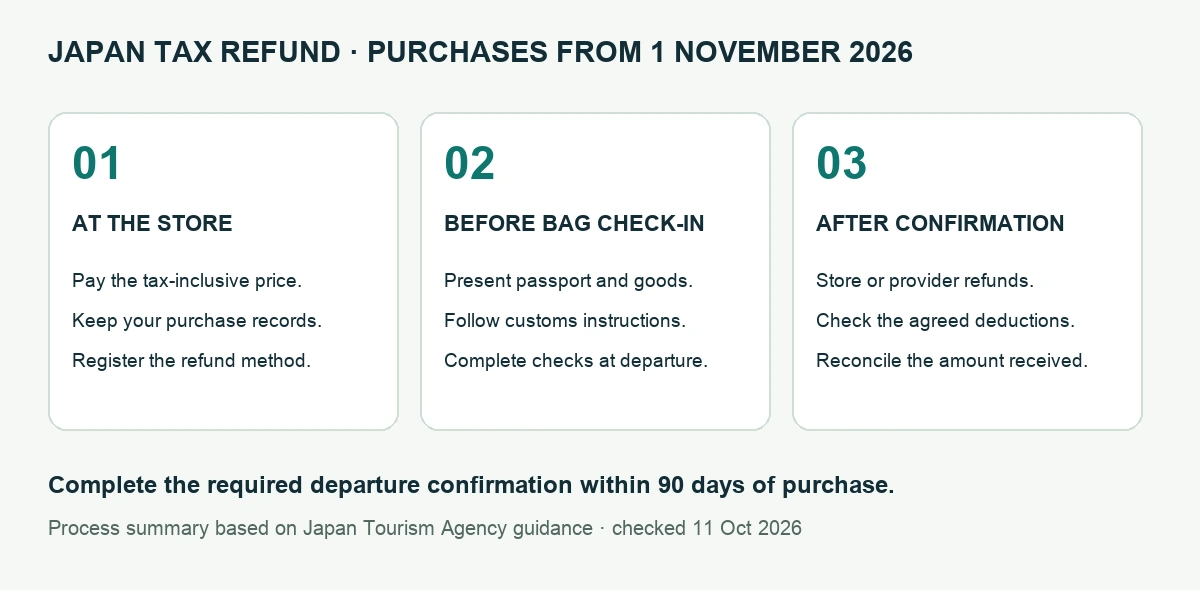
The Japan National Tourism Organization confirms the change for purchases made on or after 1 November 2026. Until 31 October, eligible tax-free purchases use the preceding point-of-sale or store-counter arrangements. From November, the buyer pays tax first and receives the refund after departure customs confirmation.
On a narrow screen, swipe a table sideways to see every column.
| Question | Purchase through 31 October 2026 | Purchase from 1 November 2026 |
|---|---|---|
| What do I budget at the store? | Follow the existing tax-free purchase or store-counter procedure. | The tax-inclusive purchase price. |
| When is the refund resolved? | Under the preceding store arrangements. | After the required customs confirmation at departure. |
| What should I ask before paying? | Eligibility, store procedure and departure obligations for the old system. | Eligibility, refund registration, deductions, payout method and departure procedure. |
The practical change for a drone buyer is cash flow. If your spending limit is based on the expected tax-free price, you may not have enough available card balance for the initial purchase. Plan for the full debit and treat the refund as a later event until it arrives.
A trip spanning October and November can contain purchases under both systems. Keep the invoices and instructions separate. Do not apply the new workflow to an October purchase merely because your flight leaves in November.
Who can buy a DJI drone tax-free in Japan?
Holding a foreign passport alone does not settle eligibility. The government’s eligible-purchaser document identifies qualifying non-residents and their required documents. For many foreign tourists, the relevant category is Temporary Visitor with the applicable entry-period conditions. Residents and people visiting under other statuses should not assume the same treatment.
Japanese nationals living abroad have a separate documented route, including evidence of continuous overseas residence. The official list explains the accepted supporting documents. Show the store your actual passport and status documentation; let it confirm which procedure applies before you buy.
Under the published new-system rules, qualifying purchases must reach ¥5,000 excluding tax per store per day, and the goods must be taken out of Japan. A drone will usually exceed the price threshold, but that does not remove the other conditions. The Japan Tourism Agency’s traveller guide is the primary reference.
Buying stock for a repair business or resale? Do not assume an ordinary tourist purchase is the appropriate route. Explain the intended use and quantity to the seller and obtain advice on the relevant commercial purchase and export process. This article’s cost examples concern an individual traveller’s equipment purchase.
How much could the Japanese tax refund save on a DJI drone?
On 11 October 2026, the official DJI Japan product page displayed ¥106,700 for the Mini 5 Pro standard package with RC-N3 and ¥150,480 for the Mini 5 Pro Fly More Combo with RC 2. These are useful retail benchmarks, not confirmed tourist tax-free offers. A participating physical shop may charge a different price or offer different stock.
Japan’s standard consumption-tax rate is 10%, including its national and local components, according to the National Tax Agency. For a qualifying invoice taxed at that rate:
Pre-tax price = tax-inclusive price ÷ 1.10
Tax component = tax-inclusive price ÷ 11
Removing a 10% tax from an already-taxed price reduces that total by approximately 9.09%, before any refund-provider deduction.
| DJI package | Assumed invoice including 10% tax | Tax component | Net if fully refunded, before fees |
|---|---|---|---|
| Mini 5 Pro, RC-N3 standard kit | ¥106,700 | ¥9,700 | ¥97,000 |
| Mini 5 Pro Fly More Combo, RC 2 | ¥150,480 | ¥13,680 | ¥136,800 |
These numbers are arithmetic examples. They assume the same invoice price, full eligibility, successful export confirmation and no deduction from the tax component. They do not establish that the DJI online store participates in a tourist refund scheme.
Why “10% off” gives the wrong answer
For the ¥150,480 package, subtracting 10% of the displayed price would remove ¥15,048 and give ¥135,432. The correct tax component for a 10%-inclusive invoice is ¥13,680, giving ¥136,800. The shortcut overstates the saving by ¥1,368.
If a seller advertises an extra promotional discount, calculate it separately and establish whether it applies before or after tax. A store coupon, consumption-tax refund and card promotion are three different adjustments; they should not be merged into one unexplained percentage.
A realistic cash-flow example with clearly stated assumptions
Assume the RC 2 Fly More package costs ¥150,480, your payment costs an additional 2%, and a hypothetical refund provider deducts ¥1,000 from the refundable tax. Neither fee is a quoted industry standard; they are example inputs to show how to budget.
| Stage | Illustrative calculation | Yen-equivalent amount |
|---|---|---|
| Purchase | Invoice | ¥150,480.00 |
| Payment charge | 2% × ¥150,480 | +¥3,009.60 |
| Later refund | ¥13,680 − ¥1,000 | −¥12,680.00 |
| Net before transport and destination costs | Purchase + payment charge − refund | ¥140,809.60 |
| If no refund arrives | Purchase + payment charge | ¥153,489.60 |
For a foreign-currency card, the actual debit and refund can use different exchange rates. Convert each transaction separately when reconciling the final cost. Add extra travel, airline baggage and destination import costs before comparing the result with buying at home.
This distinction also matters if the drone develops a fault before your flight. Ask how a return or replacement affects the purchase record and any refund registration; keep the corrected paperwork together rather than relying on the original receipt.
What to ask the store before buying
Start with the exact package name. For example, ask for the Mini 5 Pro Fly More Combo with RC 2 and standard batteries, not the Plus package, an RC-N3 bundle or a refurbished unit. A low “from” price cannot answer that question.
You can show the following checklist to the shop:
- “Can this branch process a tourist tax-free purchase for my passport and entry status?” Confirm the branch and transaction, not merely the chain’s general policy.
- “What is the tax-inclusive invoice total for this exact package?” Ask whether the quote includes all accessories you expect.
- “Who will issue the refund, and what must I register now?” Obtain the provider name and instructions.
- “What deductions apply, and what net refund should I expect?” Ask for currency, fees and any conversion treatment.
- “How will I recognise the refund, and who handles missing payments?” Keep the support contact and transaction reference.
- “What happens if I return or exchange the drone before departure?” Make sure the paperwork can be reconciled.
- “Which DJI service region covers this unit?” Ask about returns after you leave Japan, not just the warranty’s duration.
- “What documents should I retain for departure and service?” Keep the invoice, package details and relevant purchase records.
A practical shopping folder can contain the quote, receipt, package label, refund-provider instructions, expected refund and departure checklist. Keep identity documents private; share them only through the official store or government process that requires them.
The new airport process: complete it before checking your bags
The official refund-method traveller leaflet places the departure procedure before baggage check-in. Do not hand over a suitcase containing the drone and then go looking for the tax-free terminal.
- Prepare access to the purchase. Keep the drone, accessories and other relevant goods accessible alongside your passport and records.
- Find the tax-free procedure terminal before baggage check-in. Follow the airport’s signage and official instructions.
- Complete the passport step and follow the result. A green result completes the customs confirmation procedure; a red result directs you to a physical inspection.
- If selected, present the goods to Customs. Keep enough time available for the inspection before continuing your departure.
- Proceed with the airline process after completing the required checks. Follow the airline’s separate battery-packing rules.
The Japan Tourism Agency requires the departure confirmation within 90 days of purchase. For a domestic-to-international connection, its guidance locates the procedure at the airport where you finally leave Japan. If an airline intends to through-check your bags, establish beforehand how you will retain access to the goods at that departure point. See the official traveller FAQ.
Do not plan around a guaranteed processing time. A quick terminal result does not tell you how long a queue or physical inspection will take. Airport arrival, airline bag-drop and boarding deadlines must all fit the itinerary.
Can Visit Japan Web replace the airport terminal?
The published arrangements also provide a Visit Japan Web route in designated international-departure areas at Narita, Haneda, Kansai, Chubu, New Chitose, Fukuoka and Naha, using the dedicated wireless network. This is a location-dependent departure process, not a refund you can complete from your hotel. Follow the official leaflet and airport instructions.
Prepare your account or records in advance if you intend to use the service, but retain the documents and goods needed for inspection. A working phone does not replace physical possession of the purchase.
The receipt-level mistake that can put the whole refund at risk
Under the published rules, customs confirmation is assessed by purchase transaction. If an item from that transaction is no longer in your possession, the other goods on the same receipt may also become ineligible for confirmation. The Japan Tourism Agency explains this receipt-level condition.
Consider a hypothetical receipt containing a drone and food intended to be eaten during the trip. Consuming the food can create a problem for the transaction that also contains the drone. Before paying, ask the shop to explain how personal-use purchases and export purchases should be recorded. Do not assume you can omit an item later and claim a proportionate refund.
For a drone bundle, keep the equipment and accessories organised so you can show what was purchased. Do not discard the receipt, transfer part of the purchase to a travelling companion or send items ahead without first checking how that affects the applicable process.
The new system removes special packaging for consumables, but that does not turn consumed goods into eligible exports. If something has been consumed or is missing, describe the situation accurately to Customs and follow its instructions.
Who pays the refund, and when will it arrive?
The store or its appointed provider handles the payout after customs confirmation. The official FAQ lists possible methods including bank transfer, card credit, app-based refund and, where offered, cash at departure. Availability and timing vary by shop. There is no basis for promising every buyer an immediate cash refund at every airport. See the refund section of the traveller FAQ.
Keep three figures in your purchase record: the invoiced tax component, any agreed deduction and the expected net refund. Then record the actual amount received in your home currency. This makes a missing refund, a conversion difference and a disclosed service fee easier to distinguish.
If the expected payment does not arrive, start with the shop or named refund provider and use the reference it supplied. Keep your receipt and departure-confirmation information available. Do not send passport images or financial details to a contact found through an unsolicited refund message.
Self-shipping the drone is not a substitute for the tourist procedure. JNTO states that the purchaser-arranged international parcel route ceased to qualify from April 2025; store-arranged direct export may be handled differently. Confirm that route with the store before committing to it. Official JNTO guidance.
Can you fly the drone in Japan before taking it home?
Tax treatment and flight permission are separate questions. Japan’s Civil Aviation Bureau states that aircraft weighing 100 g or more fall within its registration requirements. Its guidance also covers identification, Remote ID and circumstances requiring flight permission or approval. A DJI Mini being around 249 g does not create a general exemption in Japan. Start with the official Japanese drone flight rules.
Do not treat this tax article as a flight authorisation. Before planning a test flight, establish the registration, airspace, operating conditions and landowner or site rules that apply. Also ask the store how activation or use affects its return policy and your specific purchase arrangements.
Pack the batteries for your actual airline itinerary
Record the battery model, Wh rating and number of spares, then check the operating airlines on all legs of the journey. For US-regulated travel, the FAA specifies carry-on carriage for spare lithium batteries and protection against short circuits. Other authorities and airlines may add conditions. A tax-free purchase does not override dangerous-goods rules.
Arrange your bags so Customs can inspect the equipment and the airline can accept the battery configuration. If your cabin bag must be checked at the gate, tell the airline about the spare batteries and follow its instructions before surrendering it.
Warranty and destination costs can outweigh the refund
DJI’s after-sales policy limits warranty service to the relevant region of purchase and requires valid purchase evidence. Confirm where your specific unit can be serviced, how a cross-border return would work and which Care Refresh terms apply. Do not treat an independent local repair option as an extension of DJI’s warranty.
At home, verify passenger allowances, declaration requirements and any equipment-specific import rules with your destination authority. The Japanese refund addresses Japanese consumption tax; it does not decide the tax or regulatory treatment in another country.
Use this decision test: home-store total − foreign net purchase cost = the amount available for every remaining expense and inconvenience. If the gap is small, local returns and service may be worth more than the remaining saving. If Japan is already part of your trip and the verified gap remains large, the purchase may be worthwhile.
Frequently asked questions
Does the new Japan tax-refund system begin in October or November?
It applies to purchases made from 1 November 2026. Keep the date on each invoice and use the procedure that applies to that purchase.
Can I claim a refund just because DJI Japan lists a price online?
No. A retail listing is a price benchmark. Confirm that the specific seller can process your qualifying purchase and explain the refund arrangements before paying.
How much is the tax in a ¥150,480 drone purchase?
If that invoice includes the standard 10% consumption tax, the tax component is ¥13,680. The pre-tax amount is ¥136,800; provider deductions and payment costs can change the final net cost.
Is there one guaranteed refund method?
No. Ask the store which payout methods its provider supports, what information you must register and what timing to expect.
What if my card is charged today but the refund comes later?
Budget for the full initial debit. Reconcile the refund as a separate transaction because timing, currency conversion and charges may differ.
Should I buy the Plus battery package because it looks like better value?
Choose it only after checking weight, operating classification, airline transport and your actual flying needs. Compare a Plus package with another Plus package rather than with a standard-battery offer.
What should I do if the drone has an error after purchase?
Record the exact message, model and circumstances and contact the seller promptly about its return or service process. Our DJI Mini error-code guide can help organise the symptoms; an error code alone does not prove a particular component has failed.
Your purchase-to-departure checklist
- Before shopping: confirm visitor eligibility, exact package, home-store comparison and payment costs.
- At the store: verify participation, obtain an itemised invoice and record the provider’s refund instructions.
- During the trip: keep the goods and records organised; resolve any return or exchange with corrected documentation.
- Before travel: check airline battery rules, your departure airport’s process and access to the goods.
- At departure: follow the official tax-free procedure before giving up access to the equipment.
- After returning: complete any destination formalities, reconcile the refund and retain service records.
Compare the full result with the same-package DJI country price table. The useful figure is the cost of a correctly documented, usable and supportable drone at home, after the refund has actually been received.